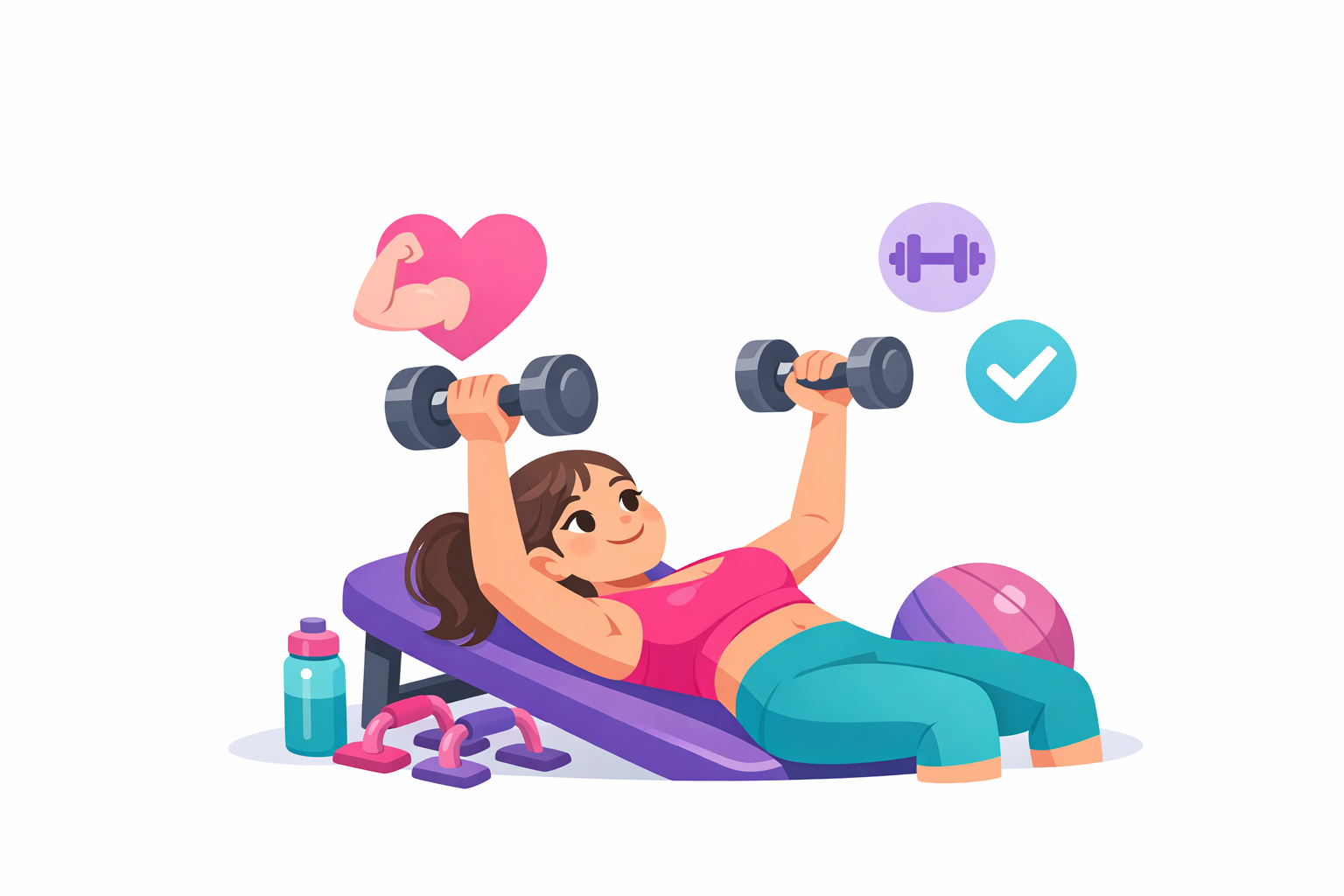

Some days it feels like the heaviest thing we lift is our bag or a toddler who refuses the stroller. Chest training helps all of that. Strong pecs make pushing, carrying, and holding better posture feel easier. And no, chest work will not make you bulky. It builds balanced strength through your front side and supports your shoulders and back.
This guide walks you through safe, effective chest exercises you can do at home or in the gym. We cover bodyweight moves, dumbbells, bands, and gym machines. You will see simple form cues in plain language, easy progressions, and options if you are pregnant, dealing with shoulder pain, or low on equipment.
Quick Comparison
What’s in this Article
- Why chest training matters for women
- How to use this guide and find it again
- Tools that make chest workouts easier
- FAQ
- Your next step this week
- Real-world tips, gear, and caveats
We wrote this for every level. If you are new, start with wall or incline push-ups. If you already bench, you will still pick up cleaner positioning, better tempo, and smarter programming. You will also find three ready-to-use routines and a quick chest circuit you can drop into a busy week.
One note before we start. If you have a fresh injury, recent surgery, or pain that changes your form, check in with a qualified pro first. This guide is educational and does not replace medical care.
Ready to build a stronger push and more comfortable posture without spending an hour in the gym? Let’s get you moving in small, doable steps.
Why chest training matters for women
Everyday wins you will feel
- Pushing strollers, grocery carts, and heavy doors feels smoother.
- Better shoulder positioning helps neck tension and bra strap digging.
- More control in push-ups, planks, and yoga flows.
- Confidence carrying kids, boxes, and that suitcase that somehow multiplied.
A quick anatomy snapshot
Your chest muscles sit across the front of your ribcage and connect your upper arm to your torso. They help move your arm across your body and push things away. They also work with your shoulder blades, lats, and core. When we train chest, we also think about what your ribs, shoulder blades, and wrists are doing so the whole front side supports you, not just the big movers.
What chest work will not do
- It will not spot-reduce fat from your chest. Fat loss is system-wide.
- It will not wreck your shoulders when you use smart range, slow lowers, and stable shoulder blades.
- It will not require fancy gear. A wall, a pair of dumbbells, or a band is enough to start.
How to use this guide and find it again
Do this first: 60-second chest prep
- Stand tall, ribs stacked over hips. Take two slow breaths into your sides.
- Do 6 scapular push-ups on a wall or counter. Keep elbows straight. Let your chest sink slightly, then press the floor away and feel your shoulder blades glide.
- Finish with 6 incline push-ups on a counter. Slow 3-second lower, steady press up. That is your micro-win for today.
Bookmark this page so it is easy to come back to: /blogs/all/chest-exercises-for-women
How we choose and cue exercises
We use clear checks to keep things safe and effective:
- Joint-friendly range. Shoulders away from ears, ribs down, wrists stacked over hands.
- Tempo control. Aim for a 2 to 3 second lower and a smooth press up.
- Pain rules. Keep it in a pain-free range. Anything above a 3 out of 10 is your cue to modify.
- Real-life carryover. Moves that help you push, carry, and stabilize.
- Simple setup. Works at home or in a small gym space.
- Scalable. Easy to regress or progress with angle changes, bands, or weight.
When to modify or skip and see a pro
- Sharp or radiating shoulder pain, numbness, or tingling during presses.
- Pregnancy in the second or third trimester if front-lying positions feel off. Use incline and side-lying swaps.
- Wrist pain during floor work. Elevate hands or use neutral-grip handles.
- History of shoulder impingement, rotator cuff repair, or diastasis recti. Keep range smaller, slow down, and focus on ribs and breath. If pain lingers, get a professional eye.
Tools that make chest workouts easier

Level up at home: 5 color-coded bands go from light toning to assisted pull-ups. Durable latex, handles, and a door anchor power full-body workouts and recovery. All levels.
$22.99 on Amazon
Price and availability are accurate as of 03/15/2026 12:13 am GMT and are subject to change.
A good resistance band set makes chest days doable anywhere. It’s gentle on shoulders, great for presses and flyes at home, and doubles as a warm-up tool before heavier lifts. If you travel or keep gear minimal, this is the easiest win for consistent training.

Switch from incline to flat to decline fast, then fold it in 3 seconds. Sturdy 600 lb bench with comfy padding and bonus bands—great for full‑body workouts in small spaces.
$47.30 on Amazon
Price and availability are accurate as of 03/15/2026 12:13 am GMT and are subject to change.
Adjustable dumbbells are clutch for small spaces and smooth progress. You can press, fly, and do pullovers without a rack, then bump the weight as you get stronger. If you want one purchase that covers most routines in this guide, take a look here Adjustable foldable home gym bench with incline/decline and resistance bands (600 lb capacity).

72 ways to train, a rock-solid 795 lb rating, and a 2-second fold that saves 80% space. Comfy, grippy 20.5-in height keeps you stable. Want to see more?
$49.99 on Amazon
Price and availability are accurate as of 03/15/2026 12:14 am GMT and are subject to change.
A supportive sports bra keeps everything comfortable so you can focus on form, not fidgeting. It’s especially helpful for push-ups, presses, and any jumping you add to circuits. If you’re returning to workouts or prefer more coverage and stay-put straps, this is a reliable pick.
FAQ
Training basics
Q: How often should we train chest?
A: Aim for 1 to 2 sessions per week with 6 to 12 total working sets. Leave 48 to 72 hours before you hit chest hard again. In full-body days, sprinkle in 1 to 2 chest moves.
Q: What rep range is best for “tone” vs strength?
A: Tone comes from muscle plus overall fat loss. For muscle, do 8 to 12 reps with steady control. For endurance, 12 to 20 reps. For strength, 3 to 6 heavier reps. Keep 1 to 3 reps in reserve.
Form and safety
Q: I feel my shoulders more than my chest. What should I change?
A: Tuck elbows 30 to 45 degrees from your sides. Keep ribs down and shoulder blades gently set. Lower slow. Press through mid palm. Try a slight incline and a shorter, pain-free range. Warm up with band pull-aparts and shoulder taps.
Pregnancy and modifications
Q: Can I train chest during pregnancy?
A: If your provider says it’s OK, yes. Swap flat back work after the first trimester for incline or standing presses. Do wall or elevated push-ups. Breathe through reps and avoid breath holds. Stop if you feel pain, dizziness, or pelvic symptoms.
If chest training has felt confusing or a little intimidating, you’re not alone. The big picture is simple. We press, we fly, we push up. We keep our ribs quiet, shoulders away from our ears, and we lower with control.
Two short sessions a week can change how you feel when you push a heavy door, carry a toddler, or hold a plank. You can do this at home with your bodyweight or bands, or in a gym with dumbbells, a barbell, or machines. Quality reps matter more than volume. Slow lowers, steady breathing, strong lockouts.
Modify for your season of life. Pregnancy, cranky shoulders, or limited gear are not roadblocks. They’re a chance to pick a version that fits today. It still counts.
If you’re looking for a nudge, pick one move and one set right now. One set of incline push-ups before your next coffee break. Done.
Your next step this week
Time-based options
- Five minutes: Do 2 rounds of 6 to 10 incline push-ups and 20 to 30 seconds of a banded chest press hold. Rest as needed.
- Ten minutes: Alternate 8 to 12 push-ups with 8 to 12 dumbbell or band presses. Add a 30 second chest opener stretch at the end.
- Twenty minutes: Pick one press, one fly, and one push-up variation. Do 3 sets each with a slow 3 second lower, 60 seconds rest, and an easy finisher of wall slides or band pull-aparts for posture.
Simple action plan
- Warm up for 3 to 5 minutes. Shoulder circles, arm swings, wall angels, light band press.
- Choose your lane: bodyweight, bands, dumbbells, or gym machines.
- Do 3 to 4 moves total. One main press, one push-up, one accessory like a fly or pullover, and one upper back balance like rows or band pull-aparts.
- Use a steady tempo. Lower for 3 seconds, pause 1 second, press up smooth.
- Stop 1 to 2 reps before form breaks. No grinding or shrugging.
- Log your sets and reps. Add 1 to 2 reps or a little load next week.
- Cool down with a doorway chest stretch and a few deep breaths.
Decision recap
- No equipment: Start with incline push-ups on a counter, knee push-ups, and time-under-tension slow lowers.
- Bands at home: Do a standing band chest press and band fly with a staggered stance. Add a push-up variation.
- Dumbbells at home: Flat or incline dumbbell press, floor press if you do not have a bench, plus dumbbell fly or pullover.
- Gym day: Bench press or chest press machine as your main lift. Add pec deck or cable fly, then push-ups for a finisher.
Real-world tips, gear, and caveats
Shareable pull-quote tips
> Press the floor away and keep your ribs down.
> Lower slow, push strong. Control builds strength.
> Shoulders down, chest proud, neck relaxed.
> Pick the version you can own today. It still counts.
> Two chest days a week, 8 to 12 hard-but-clean reps, is plenty.
Helpful gear if you want it
You do not need fancy gear to get strong. If you like having options, these types of products are genuinely useful:
- Long-loop resistance bands with handles or anchor attachment for presses and flys.
- Adjustable dumbbells that click up in small jumps so you can progress steadily.
- A sturdy flat or adjustable bench, or a wedge to create a gentle incline.
- Push-up handles or parallettes if your wrists prefer a neutral grip.
- A supportive, non-chafing sports bra so you can focus on the work, not the bounce.
Edge cases and when to modify
- Shoulder pain or pinching: Skip deep fly stretches. Shorten range, keep elbows slightly bent, switch to a neutral grip floor press, or try a machine chest press for more joint control. If pain lingers or radiates, check in with a clinician.
- Pregnancy or postpartum: After the first trimester, favor incline presses, standing band work, and side-lying positions. Avoid long periods flat on your back if you feel lightheaded or short of breath. Exhale on effort and keep reps conversational. For diastasis concerns, stay submaximal and watch for doming.
- Recent chest or shoulder surgery, or breast procedures: Clear exercise choices and loading with your care team. Start with pain-free range, light bands, and posture work. Progress slowly.
- Wrist grumpiness: Use fists on a mat, push-up handles, or a neutral-grip dumbbell floor press to keep wrists happy.
You’ve got options, and none of them require a perfect week. Choose the version that fits your body, your energy, and your gear. Then stack small wins. Today, try one set of incline push-ups or a single banded press set. Close the laptop, hit the set, and you’re already building a stronger chest.
Leave a Comment