
What’s in this Article
- Why postpartum sizing feels confusing
- Sports bra designs that work for nursing
- FAQ
- Simple size and purchase checklist
- FAQ
Finding a sports bra that supports nursing and real workouts can feel like a moving target. Our bodies are changing, our schedules are wild, and comfort matters more than ever. The goal here is simple. Let’s get you into a bra that lets you feed or pump quickly and then move without bounce or pinching.
We’re going to keep this practical. We’ll cover why your size may be different this month than last, how to measure at home in minutes, and what design details actually make nursing easier. We’ll also talk through fit checks you can do in your living room and how to plan for those daily size swings that come with milk supply.
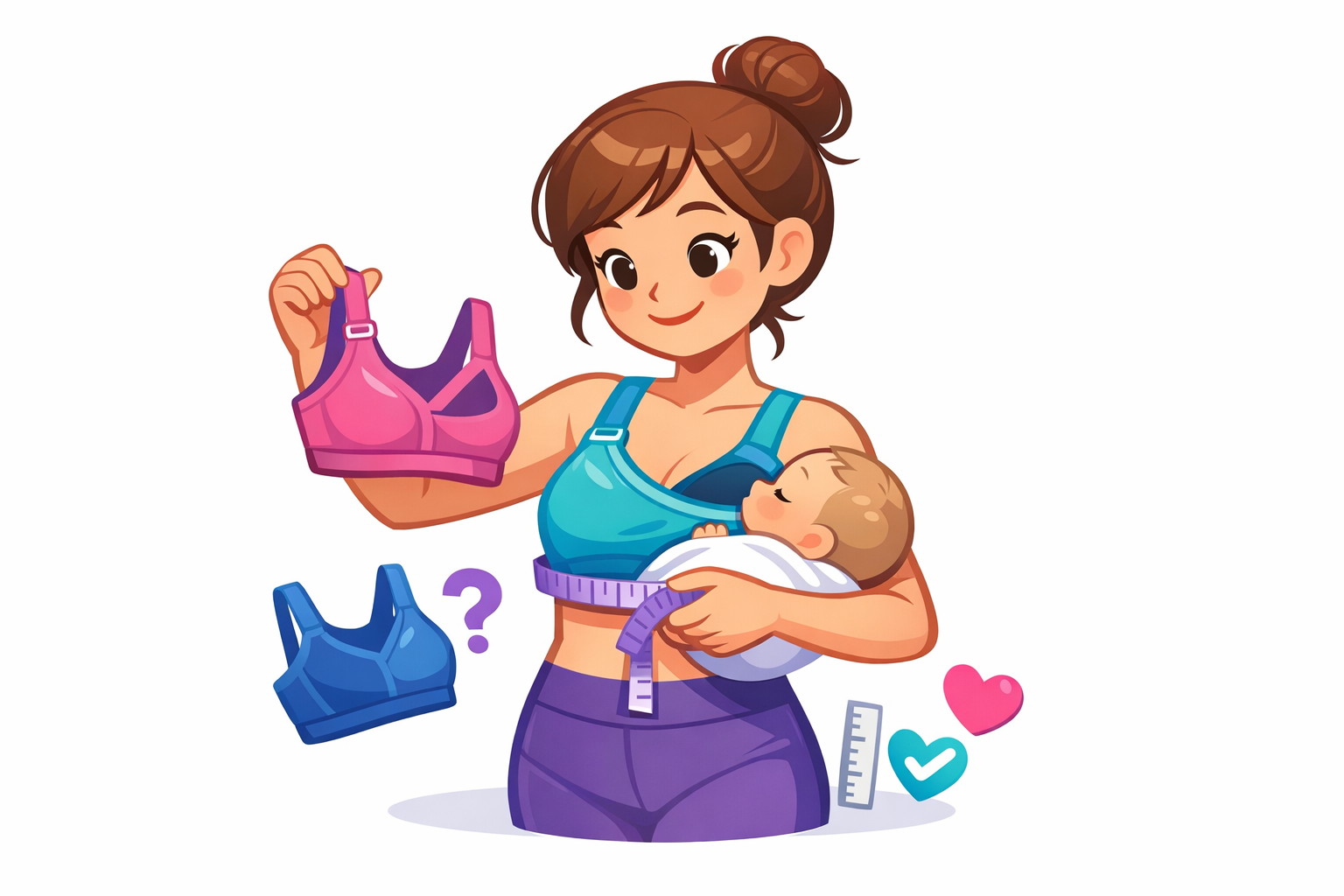
Before you do anything else, do this first: grab a soft tape measure and take your measurements after a feed or pump when your breasts are soft. Wear a thin, non-padded bra or a fitted tee. Stand tall, breathe normally, and note your underbust and full-bust numbers. That one step sets you up for a better fit.
A quick reality check. No single bra will fit perfectly at every hour of the day. If you’re dealing with engorgement, clogged ducts, or healing after a C-section, you may need gentler compression and extra adjustability. That’s normal. We’ll show you how to work around it.
Why postpartum sizing feels confusing
Hormones, milk volume, and timing
Prolactin, oxytocin, and fluid shifts change breast size across the day. Many of us measure a full cup bigger in the morning than at night. If you size up based on peak fullness, you risk a loose, bouncy fit later. If you size down at your smallest, you risk pressure and blocked ducts when you are full. Plan for both moments.
Ribcage and torso shifts
Pregnancy can widen the ribcage and change your posture. Early postpartum, your underbust may still be expanded. Over weeks and months, it can settle. That means your band size might drop as you recover. Look for bands with multiple hook positions or adjustable closures so the same bra can follow your ribcage back down.
Support vs compression while protecting supply
High compression can feel secure, but too much pressure across breast tissue can irritate ducts. We want firm anchoring from the band and targeted control up top without squashing the breast base. Encapsulation styles that shape each breast separately often give better support with fewer hot spots than flat compression alone.
Sports bra designs that work for nursing
Access methods that actually open wide
We need one-hand access that opens far enough for a deep latch or a pump flange. Common options include:
- Drop-cup clips that release the entire cup
- Center zips you can crack open quickly
- Overlap panels that pull aside without hardware
Test the opening with a pump flange. If it snags or squeezes, it will slow you down when baby is hungry or you are mid-interval.
Straps, bands, and adjusters to look for
Adjustability is your friend. Racerback feels secure, but traditional straps with sliders let you fine-tune lift as your size changes. A firm, wide band does the heavy lifting and should sit level without riding up. If the band is on the tightest hook on day one, it is too small. If you can easily slide several fingers under it, it is too loose.
Fabric and construction details for sweat and stretch
Sweaty workouts need quick-dry fabric with good stretch recovery so the bra keeps its shape. Flat seams or bonded edges reduce rubbing on tender skin. Mesh zones can help with airflow, but make sure they do not line up with pump edges.
Key evaluation criteria we use:
- Band firmness and width for anchoring
- Cup separation or shaping to avoid uniboob heat and friction
- Stretch recovery so the bra does not bag out after a few wears
- Nursing access that opens one-handed and fits a flange
- Strap adjustability to tune lift as your size changes
- Bounce control that matches your activity level without pressure points
One caveat. Underwires can work for some of us, but they must fully surround the breast tissue and sit on the ribcage, not on ducts. If you are prone to clogs, start wire-free and reassess after supply stabilizes.
FAQ
Sizing and fit
Q: How often should we re-measure postpartum?
A: Every 4 to 6 weeks in the first six months, and anytime your weight shifts, your supply changes, your period returns, or you change your pump schedule.
Q: How tight should a nursing sports bra feel?
A: Like a firm hug. You should slide two fingers under the band, take a full inhale, and move without pinching. No spillage at the top or sides. Straps support but do not dent.
Nursing and workouts
Q: Can we nurse or pump in a high-impact bra?
A: Yes, if it has drop-down, zip, or pull-aside cups. Nurse or pump 15 to 20 minutes before you train to reduce pressure. Use pads for leaks and change out of a sweaty bra after.
Q: Will compression lower milk supply?
A: All-day, very tight compression can raise the risk of clogged ducts. Pick encapsulation or light-to-moderate compression. Do not sleep in a compressive bra. If you feel tender spots, loosen the band or switch styles.
We covered a lot, but the heart of it is simple. Your body is changing, your milk supply is changing, and your bra should adapt without digging, slipping, or blocking flow. Measure at home, pick a style that matches your workouts, and build in adjustability so you can breathe and nurse without stress.
In practice, that looks like two sizes or two bras on rotation, quick fit checks before a workout, and fabrics that feel good against pump parts and tender skin. When in doubt, loosen the band for comfort and tighten straps for support rather than going down a size too soon. Comfort first, then bounce control.
If you are returning to high impact, look for encapsulation support with adjusters. For walks and yoga, soft compression with easy nursing access is enough. Expect your size to shift in the first months. Plan for it and you will feel better in your clothes and in your workouts.
Simple size and purchase checklist
- Measure band and bust today, then again in 2 to 4 weeks
- Convert to size using both numbers, then cross check your sister sizes
- Choose style by workout: compression for low impact, encapsulation for high impact
- Prioritize adjustability: back band, straps, and at least one-handed nursing access
- Do a 60 second living room fit test before removing tags
- Move in it: jog in place, reach overhead, nurse or simulate a feed
- Keep one backup size for full days or supply surges, return what you do not need
Decision recap
- If you leak often or pump, pick quick-drying, smooth fabrics and easy one-handed access.
- If you are above a D cup or running, go encapsulation with a firm band and adjustable straps.
- If you are early postpartum and size is swinging, start with a flexible band and multiple hook positions.
- Sensitive nipples or friction points mean flat seams or seamless cups and soft liners.
Fit checks to run today
- Band: snug on the loosest hook, two-finger fit, no ride up when you lift your arms.
- Cups: breast tissue fully contained with no gaping, no spillage by the armpit.
- Straps: supportive but not digging, you can slide one finger under.
- Movement: light jogging test with minimal bounce and easy, pain-free breathing.
- Nursing: you can open and close the access clip with one hand.
Edge cases and when to get help
- If you feel painful pressure, warmth, or see redness, loosen the band, avoid tight compression, and talk to a lactation pro or your clinician. You might be flirting with a clog or mastitis.
- If you had chest surgery or augmentation, sizing and pressure tolerance can be different. Book a virtual fitting or specialty bra consult.
- Twins or oversupply often need more adjustability and breathable fabrics to manage fullness swings.
FAQ
How often should I remeasure postpartum?
Every 2 to 4 weeks for the first three months, then whenever your workouts or feeding patterns change. Measure again after you start solids or wean.
Can a sports bra cause clogged ducts?
A bra that is too tight in the band or has hard seams pressing into breast tissue can contribute. Keep pressure even, avoid harsh underband edges, and do not stay in sweaty bras for hours.
Do I need two different sizes?
Many of us do. One for peak fullness or long outings, and one for later in the day or after a feed. If budget is tight, pick one adjustable bra with a wide hook range.
What if I am between sizes?
Try your sister size. If the band is tight but the cup fits, go up a band and down a cup. If the band is loose but the cup fits, go down a band and up a cup.
Can I run in a nursing sports bra?
Yes. Choose encapsulation, adjustable straps, and a firm band. Test bounce at home. If you are still uncomfortable, layer a light compression bra over your nursing bra for short runs, then change out of it promptly.
How do I handle pumping at the gym?
Look for nursing bras that are pump-compatible or pair a light hands-free pumping band under a zip or clip-access sports bra. Keep a spare dry bra in your bag.
Will my size go back to pre-pregnancy?
Maybe, maybe not. Some people do, many do not. Focus on current fit. When your feeding journey shifts, reassess and update your size.
You have permission to keep this simple. Measure, choose for your workout, test the fit at home, and adjust as your body changes. We are rooting for you to feel supported, comfortable, and ready to move.

Leave a Comment