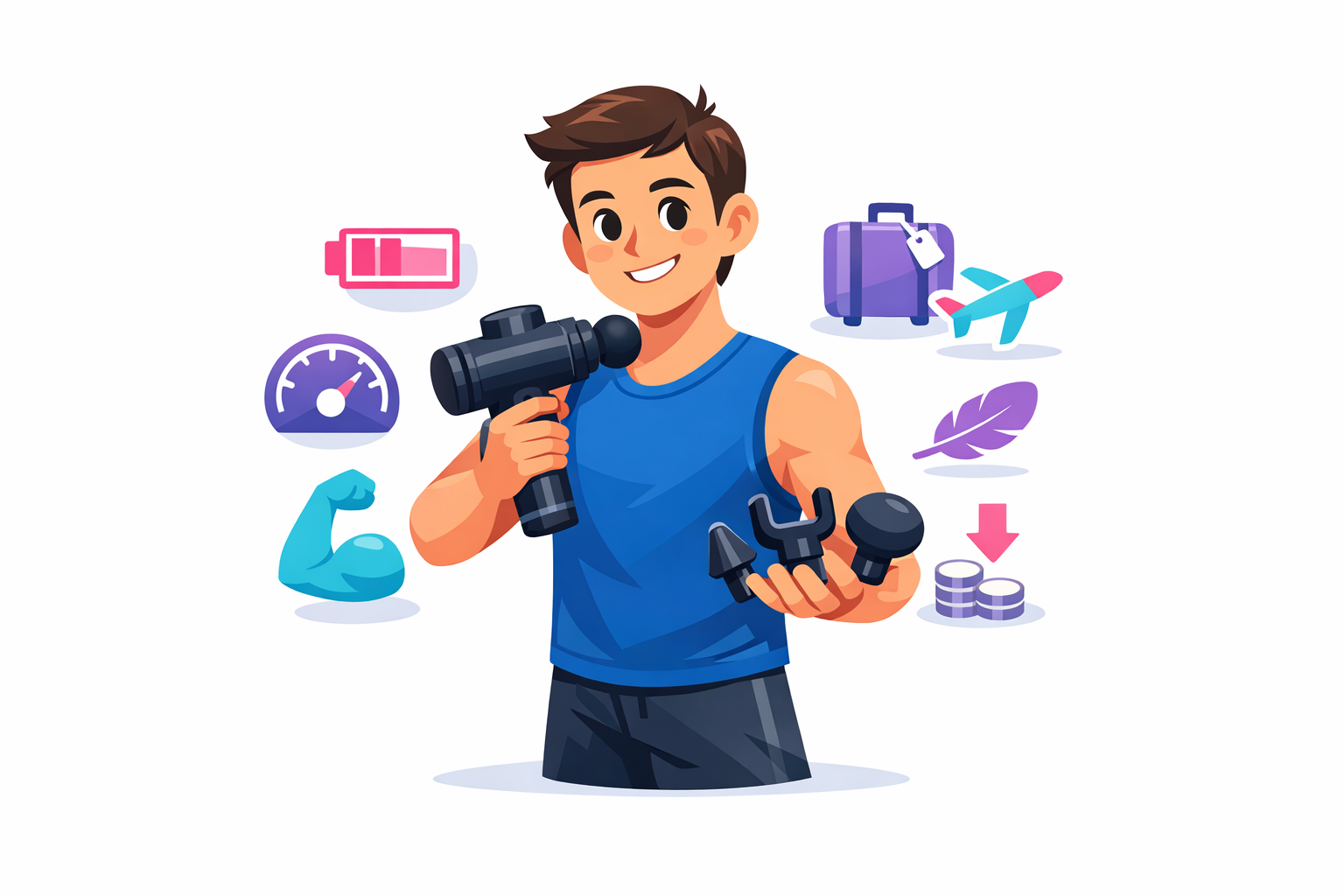

If your current massage gun feels more like a tickle than relief, you’re in the right place. High‑power models can reach deep tissue, handle big muscle groups, and keep going when you lean in. That power can speed up warmups, help you cool down, and make tight spots feel workable instead of stubborn.
This guide is for anyone who lifts, runs, rides, or chases kids all day and wants something that actually moves tension. It’s also for folks who bought a budget device that stalls on quads and hamstrings and are ready to upgrade without buying more than they need.
Quick Comparison
What’s in this Article
- Supplies that make deep-tissue work easier
- FAQ
- Keep your recovery rolling
- Your buy‑and‑try checklist
Our goal is simple: help you match real specs to real bodies and routines. We’ll translate the numbers into how it feels on your calves, glutes, and between‑the‑shoulder‑blade knots. By the end, you’ll know what stall force, amplitude, and RPM mean, what matters for quiet use at home, and how to choose your best fit for strength, travel, or sensitive spots.
Do this first: pick your main job for a massage gun. Warmup before workouts. Post‑lift recovery. All‑day desk shoulders. General relaxation. Your top job should drive the power you choose.
Two quick reality checks:
- More power is not always better. If you’re petite, new to massage, or have very sensitive areas, a heavy hitter can be too intense on bony spots.
- Massage guns are not medical treatment. If you have an acute injury, numbness, or a condition like DVT or pregnancy, talk to your clinician before using percussion massage.
Why a high‑power massage gun and who needs one
- Stronger motors resist stalling so you can press into big muscles without the head stopping. That keeps pressure consistent and saves your grip.
- Longer stroke depth reaches deeper tissue. Great for glutes, hamstrings, quads, and lats.
- Faster percussions per minute help with warmups when you want a quick, buzzy prime.
Signs you’ll benefit from more power
- Your current gun stops or slows when you press into quads or glutes.
- You can’t feel much under thick leggings or on dense areas like calves.
- You want shorter sessions that still feel effective.
When lighter tools are the better call
- You’re very new to percussion massage or prefer gentle pressure.
- You mainly work bony areas like traps close to the neck or forearms.
- You need a tiny, quiet travel buddy for quick tune‑ups on the go.
Set a goal and a limit
- Goal: pick two target muscles and decide if you want deep recovery or quick activation.
- Limit: choose a noise tolerance and max weight you’re willing to hold for 5 minutes per side.
Quick buying guide to the specs that actually matter
Numbers are helpful when they describe feel. Here’s how we evaluate high‑power massage guns for real life.
Stall force and torque
- What it is: how much pressure you can apply before the motor stalls.
- Why it matters: higher stall force means you can lean into quads and glutes without the head stopping. It’s the real “strength” metric.
Amplitude and RPM
- Amplitude: the depth of each stroke in millimeters. Bigger number equals deeper reach.
- RPM: percussions per minute. Higher RPM feels brisk and buzzy. Depth plus speed creates that deep‑but‑not-harsh sweet spot.
Battery life and charging
- What to look for: 2 to 5 hours of real use, USB‑C or a stable barrel charger, and ideally a removable battery if you train daily.
- Why it matters: dead batteries kill habits. Removable packs help heavy users or shared households.
Noise level and motor quality
- What to look for: quiet brushless motors, solid build, and reported dB under load.
- Why it matters: you’ll actually use it on the couch or during a show if it doesn’t sound like a power tool.
Size, weight, and ergonomics
- What to look for: 1.5 to 2.5 pounds is common. Angled or rotating handles help upper‑back reach. Good grip reduces hand fatigue.
- Why it matters: power is pointless if your hand taps out first.
Attachments and materials
- Look for: a cushioned head for sensitive spots, a ball for general use, a flat head for quads and glutes, a cone for trigger points, and a fork for calves or along the spine.
- Why it matters: the right head lets you go gentler or deeper without cranking speed.
Warranty and support
- Look for: at least 1 year of coverage and easy‑to‑find replacement parts or batteries.
- Why it matters: motors and batteries are the wear points that need backing.
Safety first
- Start low, keep the head moving, and avoid bones, joints, and your neck front.
- Limit any one spot to 1 to 2 minutes. If you feel numbness or sharp pain, stop.
- If you have a medical condition, check with your provider before use.
Quick micro‑test you can try in store or at home:
- Start on the lowest speed.
- Glide over your quad for 30 seconds with a cushioned or ball head.
- Gently add pressure until you feel a clear pulse under the skin without sharpness.
- If it stalls easily or you feel nothing, you likely need more stall force or a deeper amplitude. If it feels too aggressive even on low, step down in power or switch to a softer head.
Supplies that make deep-tissue work easier
Quick note before we share favorites: you can follow this guide and get great results with any massage gun you already own or can borrow. If you’re ready to upgrade and want options that match the use cases we cover, these are solid, high‑power picks we trust.
Deep reach, pro power

Need real deep-tissue relief? This PT-designed massage gun hits 16mm/85lb, has a rotating arm for tricky spots, runs ultra-quiet, and packs 7 heads. FSA/HSA eligible.
$199.99 on Amazon
Price and availability are accurate as of 09/10/2026 08:19 pm GMT and are subject to change.
If you’re checking boxes for real force and depth, the BOB AND BRAD D6 Pro hits both. Its 16 mm amplitude reaches deep, and the 85 lb stall force lets you lean in on quads and glutes without stalling. It stays quiet for late‑night sessions and is FSA/HSA eligible, which can help with budget planning. We reach for it when our legs feel cooked and we want heavy pressure with control. If that sounds like your lane, you can peek specs and availability here BOB AND BRAD D6 Pro Massage Gun – 16mm Deep Tissue, 85 lb Stall Force, Quiet, FSA/HSA Eligible.
Attachment variety on a budget

Recover faster with quiet, powerful percussion. 10 speeds, 9 heads target any muscle, and the 6-hour battery plus travel-ready design keeps relief handy from gym to on the go.
Price and availability are accurate as of 09/11/2026 09:13 pm GMT and are subject to change.
The Lifepro Sonic Pro is great when you want to experiment. With 10 speeds and 9 heads, it makes it easy to match the right combo to calves, traps, or feet without overthinking it. Power is solid for everyday tight spots, and the price is friendly if you’re just getting started and want options without the pro‑level cost. See current bundles and colors here Lifepro Sonic Pro Deep Tissue Massage Gun – 10 Speeds, 9 Heads.
Long sessions, big muscles

Deep, comfy relief without the sting—12mm percussion, 70lb stall force, 4–8h battery. Quieter hidden vents + travel case. Eco-certs too. Worth a closer look.
$129.99 on Amazon
Price and availability are accurate as of 09/10/2026 08:31 pm GMT and are subject to change.
Opove M3 Pro 2 balances strength and endurance. The 70 lb stall force supports firm pressure on glutes, hamstrings, and back, while the long battery life makes it a good pick for coaches, partners who share, or marathon recovery days. It stays relatively quiet and feels steady in hand, which helps with consistent tempo when you’re working through tight hip flexors.
Warmup and cooldown head

Heat or chill in seconds with a titanium head that targets deep. Quiet 55 lb power, 5 speeds, and 6 attachments—easy, tailored relief. See which setup fits you?
$129.99 on Amazon
Price and availability are accurate as of 09/11/2026 02:18 pm GMT and are subject to change.
BOB AND BRAD X6 Pro Max stands out for the heated and cold metal head, which can warm tissues before you move or add a cool finish after heavy lifts. The smooth metal glides over leggings or light lotion, and the 6 attachments cover most zones from calves to lats. If you like the idea of adding temperature to your routine, this one is worth a look BOB AND BRAD X6 Pro Max Massage Gun with Heat & Cold Metal Head and 6 Attachments.
FAQ
Setup & Use
Q: How hard should I press and how long should I stay on a muscle?
A: Light to moderate pressure. Let the head bounce, not grind. Start on low speed for 30 to 60 seconds per muscle group, up to 2 minutes for big areas like glutes or quads. If you feel tingling or sharp pain, back off or move on.
Q: Which attachment should I use where?
A:
- Ball or cushion: most muscles, daily use
- Flat: quads, glutes, hamstrings
- Fork: along the spine or Achilles, not directly on bones
- Cone or bullet: trigger points, feet, small knots
Swap to softer heads for bony or tender areas.
Safety & Health
Q: Who should avoid high-power massage guns or check with a doctor first?
A: If you’re pregnant, have a pacemaker, clotting issues, neuropathy, uncontrolled diabetes, recent surgery, or an acute injury, talk to your provider first. Skip use on open wounds, swollen areas, fractures, or directly over the neck front, spine, and joints.
Troubleshooting & Care
Q: Why does my massage gun stall or feel weak?
A:
- Charge it fully and seat the attachment all the way in
- Use a higher speed with lighter pressure; pressing too hard stalls motors
- Clean vents and remove lint from the head and shaft
- Let it cool if the handle warms up
- If power fades fast, your battery may be aging and needs replacement if supported
You have the specs. You have the use cases. Now it is about choosing the tool that fits your body and your life. Power is stall force. Feel is amplitude. Speed fine tunes sensitivity. Battery and noise decide how often you will actually use it.
If you are an athlete or you love heavy lifts, lean into higher stall force and 14 to 16 mm amplitude. If you are sensitive, share walls, or want a travel buddy, go lighter, quieter, and closer to 10 to 12 mm amplitude. Attachments are your steering wheel. Ball and flat do most of the work. Fork and cone are for small jobs.
You do not need to overthink this. Start light, keep the head moving, and let the percussion do the work. One to two minutes per muscle is plenty. Consistency beats hero sessions.
Keep your recovery rolling
Daily habits that pair well
- Do a 5 minute mobility flow before or after you use the gun. Ankles, hips, T‑spine.
- Hydrate and get a protein hit within a couple hours of training.
- Stack a light walk or 10 minutes of zone 2 on easy days. Blood flow helps.
- Warm tissues first if you run cold. Quick shower or heating pad helps the gun feel better.
- Sleep is recovery. Aim for a steady bedtime and cool, dark room.
Safe use cadence
- Time on tissue: 30 to 120 seconds per muscle group. Sweep slowly, about 1 inch per second.
- Pressure check: if the motor stalls, you are pressing too hard. Back off and let speed do the work.
- Frequency: daily is fine at light pressure. Go gentler on back‑to‑back heavy training days.
- No‑go zones: front of neck, directly on spine, over bruises, open wounds, varicose veins, or areas with reduced sensation.
- Post‑session: tissues should feel warm and looser, not tender to the touch. Soreness that lingers means ease up next time.
Quick maintenance routine
- Wipe the handle and heads after each use. Sweat breaks down foam over time.
- Rotate heads so foam tips dry fully between sessions.
- Charge when you hit one bar. Storing between 20 and 80 percent is kind to lithium batteries.
- Keep it in the case. Dust and grit shorten motor life.
- Check the attachment fit weekly. If a head wiggles or foam cracks, replace it.
Your buy‑and‑try checklist
Decide in 60 seconds
- Amplitude: pick 14 to 16 mm for a deeper punch. Choose 10 to 12 mm if you prefer a gentler feel and quieter sessions.
- Stall force: 40 to 60 pounds for athletes and dense legs. 25 to 40 pounds covers most daily use.
- Noise: under 50 dB if you live with roommates or use it while watching TV.
- Weight: under 2 pounds if you plan to travel or have small hands. Ergonomic grips help more than you think.
- Battery: 2 to 4 hours is plenty for home use. Removable batteries are nice for teams or clinics.
Before you hit purchase
- Grip test if you can. Angled or triangular handles reduce wrist strain.
- Look for the core heads: ball, flat, fork, cone, and a soft cushion.
- Check warranty terms and how to contact support. One to two years is common.
- Confirm a reasonable return window. Try it on your worst tight spot within that time.
- Note charging style. USB‑C is simple for travel. Proprietary docks are fine for home bases.
Your first week with the gun
- Start on the lowest speed. Turn up only if you need more.
- Map your top three zones. Common ones are calves, quads, and upper glutes.
- Set a 2 minute timer per area so you do not overdo it.
- Keep the head floating. Think glide, not dig.
- Jot quick notes on what helps. Speed, head type, and time. Patterns show up fast.
Edge cases to pause and ask a pro
- Pregnancy or postpartum. Avoid abdomen and lower back. Get clearance from your provider.
- Blood thinners, clotting disorders, or history of DVT. Skip percussion until cleared.
- Recent surgery, acute injury, or severe swelling. Wait for healing and a green light.
- Neuropathy, pacemaker, or implanted devices. Avoid use near devices and get medical advice first.
Ready to pick? Narrow to two options that fit your amplitude and stall force needs, then let noise and grip decide. Set a budget you feel good about, order from a retailer with an easy return, and give it one honest week. If it helps you move more and recover better, you found your match.



Leave a Comment