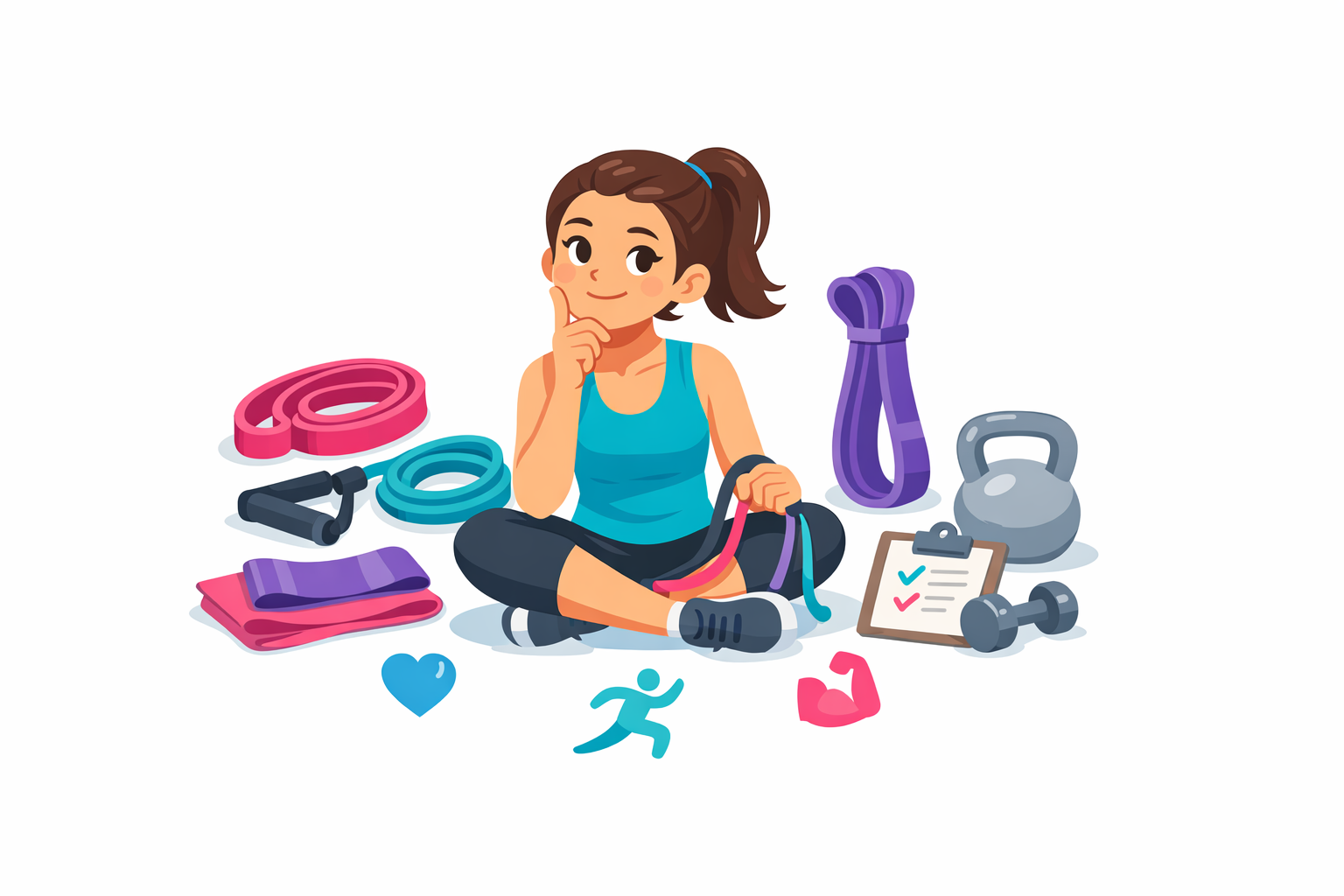

Busy week, low energy, and you still want a workout that actually fits your life. Resistance bands are perfect for that. They’re small, quiet, and surprisingly strong. The trick is choosing the right ones so you’re not fighting your gear instead of training.
This guide is for beginners and intermediate lifters who want clear answers. Whether you’re rehabbing a cranky shoulder, building strength at home, adding assisted pull-ups, or packing a travel-friendly HIIT kit, we’ll help you pick bands that feel good and do the job.
Quick Comparison
What’s in this Article
- Start With Your Goal: Match Band Type to How You Train
- Features That Matter Before You Click Buy
- Supplies that make this easier
- FAQ
- Ready to Train?
- What to Read Next and Tools
By the end, you’ll know which type of band matches your goal, what resistance level makes sense for your current strength, and how to size bands so they work with your height and space. No guesswork. Just a plan you can use today.
Do this first: choose one primary goal for the next 6 weeks. Rehab and mobility, strength, assisted pull-ups, or HIIT. Everything gets easier once you pick one lane.
Two quick notes to set expectations. Color is not universal. A green band from one brand can be very different from another. Also, if you have a latex allergy or very sensitive skin, you’ll want non-latex options or fabric-coated bands.
Start With Your Goal: Match Band Type to How You Train
Rehab and mobility days
- What you want: smooth tension, small jumps in resistance, lots of control.
- Best fit: therapy bands or light long loop bands. Therapy bands are flat, wide strips without handles that feel gentle on joints. Long light loops work for pull-aparts, face pulls, and hip mobility.
- Tip: aim for sets where you can move slowly and still feel tension at end range.
Strength and muscle building
- What you want: bands that load the mid and end range of a movement, options to stack resistance, and simple anchoring.
- Best fit: long loop bands for deadlifts, rows, presses, and hip hinges. Tube bands with handles for presses and rows if you prefer a grip that feels like dumbbells.
- Tip: pick resistances that land you around 6 to 12 tough reps. You can double up bands to fine-tune the load.
Assisted pull-ups and conditioning work
- What you want: sturdy bands that assist vertical pulling or power quick circuits without constant fiddling.
- Best fit: long pull-up loop bands for assisted pull-ups and heavier rows. Mini bands for glutes and core finishers. Tube sets with a door anchor for fast exercise swaps during HIIT.
- Tip: if you’re between assistance levels on pull-ups, choose the lighter band and add a controlled negative on the way down.
Features That Matter Before You Click Buy
Material and feel
- Latex delivers the best stretch and snap-back. Non-latex options exist if you’re sensitive and usually feel a bit stiffer. Fabric mini bands are comfy on skin and don’t roll as much, but they have a shorter stretch range.
- Check edge finish. Smooth, rounded edges roll less on thighs and forearms.
Resistance range that fits you now
- Bands are measured by tension at a given stretch. Look for an estimated pound or kilogram range. If you’re new to bands, start lighter than you think and layer up.
- Expect to combine bands for small jumps. That’s normal and useful.
Length, setup, and anchors
- Long loop bands around 41 inches circumference are the most versatile for full-body work and pull-up help.
- Tube sets with handles work well if you like a dumbbell feel and quick anchors. Make sure a door anchor is included and fits your door without gaps.
- Measure your training space. You’ll want at least your arm span plus a step back from the anchor.
Safety, durability, and care
- Look for thick, continuous-layer latex or clearly stated non-latex. Stitched fabric seams on mini bands should lie flat.
- Warranty and replacement parts matter for tube sets. Handles and carabiners take abuse over time.
- Quick check before each use: no cracks, no thin spots, no frays at the anchor point. Store bands out of sun and away from heat.
Supplies that make this easier
Quick note before we shop: you can follow this guide with any basic band you already own. If you want gear that lines up cleanly with the steps and use-cases we covered, these are solid picks we trust.
Glute and HIIT loops

5 levels, latex-free, no-roll loops for glutes, rehab, and travel. Skin-friendly TPE + carry bag make quick workouts easy anywhere. Worth a look.
Price and availability are accurate as of 10/23/2026 02:35 pm GMT and are subject to change.
If you’re building a lower-body routine or adding quick HIIT finishers, this latex-free mini loop set keeps tension smooth without the snap-and-slide drama we all hate, and it matches the activation and mobility steps in this guide; if you’re ready to grab a set that travels well and covers five clear levels, see MeeRoh Mini Loop Resistance Bands (5 Levels) – Latex-Free, Non-Slip Glute Bands with Carry Bag.
Gentle rehab and mobility

Color-coded TPE bands built to resist snapping. Light/medium/heavy for strength, rehab, and stretching. Folds flat for travel. Pick your level.
Price and availability are accurate as of 10/23/2026 10:25 am GMT and are subject to change.
When your goal is form, range, and slow strength, these flat therapy bands give you clean, gradual resistance for the shoulder series, ankle mobility, and core work we mapped out; they’re simple, versatile, and a smart pick if you’re easing back in after a layoff or injury, and you can check specs and levels at Latex-Free Flat Resistance Bands 3-Pack (5 ft) for Stretching & Rehab.
Pull-up assist and strength

Four color-coded bands (10-125 lb) help you nail pull-ups and scale strength. Combine as you progress. 41 in loops travel light – pick your level.
$74.99 on Amazon
Price and availability are accurate as of 10/23/2026 04:02 pm GMT and are subject to change.
Ready to chase your first pull-up or add real resistance to rows, presses, and deadlift patterns at home, this long-loop set slots neatly into the assisted-pull and strength paths in our flowchart; start with a heavier band, then drop to lighter support as you get stronger, and see the pack details at WODFitters Resistance Loop Bands 4-Pack for Assisted Pull-Ups, Muscle-Ups & Mobility.
Budget-friendly starter set

Build strength anywhere with 5 latex bands (10-40 lb). Skin-friendly, snap-resistant, and travel-ready with a tote and guide, great for full-body toning or rehab. Pick yours.
$6.99 on Amazon
Price and availability are accurate as of 10/24/2026 07:13 am GMT and are subject to change.
If you want an affordable way to follow our beginner workout and build a habit, this simple loop set checks the boxes for activation, legs, and at-home HIIT without taking over your space; you can start today with one band for squats and bridges, then add levels as needed, see options at Exercise Loop Bands with 5 Resistance Levels for Legs, Glutes & Home Workouts.
FAQ
Setup & Safety
Q: How do I anchor bands safely at home?
A: Use a solid, non-movable point like a closed door with a door anchor, a heavy rack, or a sturdy post. Wrap the band around a smooth surface at hip or chest height, protect it with a towel if needed, and stand so the anchor is between you and the free end. Test with a few light reps before going hard.
Q: How far can I stretch a band without risking a snap?
A: Stay around 2 times the resting length, and avoid going past 2.5 times. Check for cracks, thin spots, or sticky patches before each set. Keep bands away from sharp edges, heat, and direct sun.
Pacing & Progression
Q: How do I pick the right resistance and progress each week?
A: Aim for 8 to 15 smooth reps where the last 2 or 3 feel tough but clean. If form breaks, go lighter or step closer to the anchor. Progress by adding a mini band to your main band, stepping back an inch or two, adding 1 to 2 reps, or slowing the tempo.
Troubleshooting & Common Mistakes
Q: My bands roll or pinch on my thighs. What fixes it?
A: Place the band above your knees, not mid-thigh. Start with light tension and smooth it flat before you move. Wear leggings for grip, try a wider fabric mini band for comfort, or use a longer loop band around the ankles for lateral work.
If you’ve made it this far, you already know more than most people buying bands on a whim. The big picture is simple. Pick your goal, match a band type to it, choose a resistance you can move with control, then size and feature-check so it fits your space and your hands.
Quick recap. Rehab or mobility often pairs best with therapy bands and light minis. Strength and full-body HIIT work well with tube sets or long loops. Assisted pull-ups call for long loop bands with heavier resistance. Color is not a standard, so always look at the pound or kilogram range, then test how it actually feels in your first set.
You don’t need a full rainbow on day one. One or two bands can cover a lot. Start small, dial in good form, and add resistance or stack bands only when reps feel smooth. We’re building a habit you’ll keep, not a gear museum.
Ready to Train?
Your 5 step action plan
- Pick one primary goal for the next 4 weeks. Rehab, strength, pull-up help, or HIIT.
- Choose the matching band type. Therapy or minis for rehab and activation. Tube or long loops for strength and HIIT. Long loops for pull-up assistance.
- Select two resistance levels. One light-to-medium for warm-ups and tempo work, one medium-to-heavy for main lifts or assisted pull-ups.
- Add one anchor or handle you’ll actually use. Door anchor if you train at home. Handles if you prefer a dumbbell feel. No extras you’ll ignore.
- Test two moves today. 2 sets of 8 to 12 reps with a full pause at the hardest point. If form wobbles, go lighter. If you speed through, go heavier or slow the tempo.
Edge cases to consider
- Latex sensitivity. Choose latex-free or fabric-coated options and confirm the material in the specs.
- Joint pain or early postpartum. Bias therapy bands or lighter minis and favor higher reps with slow tempo. If pain lingers, stop and check with a clinician.
- Old or sun-baked bands. Retire them. If there are cracks, chalky spots, or thinning, replace before they snap.
- Door setups. Only anchor to a sturdy hinged side at shoulder height or lower, and tug-test before loading. Skip glass doors.
- Heavy pull-up assistance. Start heavier than you think, then work down as you gain control. It is normal to need more help at the bottom than the top.
Quick safety reset
- Inspect before every session. Look for nicks, tears, or sticky spots.
- Set a clear training zone. No sharp edges, no rough brick anchors, no stepping on bands with gravel.
- Control the return. The last few inches of the negative build most of the stimulus, and reduce snap risk.
- Store smart. Wipe sweat, let dry, and keep out of direct sun or hot cars.
What to Read Next and Tools
Helpful reads
- Exercise Bands Sizing and Resistance: a deeper dive on length, thickness, and how to stack bands without guesswork.
- HIIT Starter Kit: simple 15 to 20 minute templates you can run with a single tube set or long loop.
- Fabric and Care Guide: how to clean latex and fabric bands so they last and stay grippy.
- Beginner Strength With Bands: push, pull, hinge, squat, carry patterns you can scale for months.
Tools to bookmark
- Band Resistance Tracker: jot down which color and setup you used for each move. Note reps, tempo, and how it felt.
- Mini Movement Library: 10 mobility and activation drills for warm-ups. Two moves a day keeps things moving.
- Weekly Check-in: one sentence on what worked, one tweak for next week. That’s it.
Tiny win to lock in today
Lay one band by your door or couch. Do 2 sets of band pull-aparts or rows while your coffee brews. If that’s all you do, it still counts.

Leave a Comment